Friday, March 24, 2017

Environmental Chambers - Elevated Humidity Applications

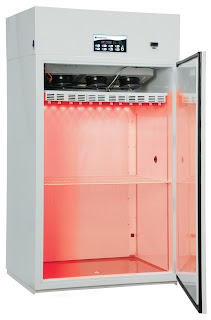
environmental control chamber for temperature and humidity stainless steel
Environmental Chamber with stainless steel
construction for elevated humidity applications.
Courtesy Powers Scientific
There are many testing, research, and production applications that require environmental moisture control at elevated levels. Environmental chamber manufacturers provide a broad offering of products, some tailored to very specific test or process requirements, others which will accommodate a wider range of operating conditions.

The challenge of product selection for a particular use can prove challenging for those not familiar with operational aspects of the equipment and systems that comprise an environmental chamber with humidity control. Selections of humidification equipment or cooling system, in particular, can have a real impact on chamber performance and maintenance requirements.

The stated performance for any environmental chamber is based upon a range of ambient conditions surrounding the chamber or its equipment. Every chamber will not necessarily work properly in every setting. It is important to consult with the manufacturer to make sure the intended use and location of the equipment is within its design range. For any unit under consideration for use, its ability to deliver needed performance levels depends, in large part, on the manufacturer's knowledge of how the chamber will be used and where it will be installed.

Generally, equipment manufacturers design environmental chambers to perform at the published design conditions when properly installed in most commercial or institutional buildings. To assure successful operation, a prospective user should consult with the chamber manufacturer's application specialists to verify there is a match between the user expectations and the equipment suitability for the project. Here are some things to consider.

  • Define the chamber conditions to be maintained. For humidity control applications, it is important for the manufacturer to know the specific combinations of temperature and humidity setpoints that will be used. For example, 80% RH (relative humidity) at +32°C. This helps the manufacturer to confirm overall chamber performance will meet user needs and verify that any options selected are compatible with the desired operating conditions.
  • Establish the range of environmental conditions that exist at the exact installation site - A humidified chamber generally has capacity to add moisture, but not remove it. Confirming the range of temperature and relative humidity conditions that can be present throughout the year helps assure that environmental chamber performance will not be adversely impacted by the surrounding air conditions.
  • Know where the heat will go - Cooling systems transfer heat from inside the chamber to outside the chamber. A unit with a cooling system of the self-contained air cooled type will reject all heat removed from the chamber, plus some extra generated by the cooling machinery, to the space surrounding the chamber. While the amount may be small, without an adequate means of removing that heat from the installation area, the temperature surrounding the chamber will rise. This is especially important when contemplating the placement of an environmental chamber within a small room with little ventilation.
  • Know what is happening in the chamber - Are you adding heat with an apparatus or piece of equipment placed in the chamber? Are materials being added to the chamber that may be at moisture or temperature conditions that differ from the chamber setpoint? These and other user associated loads can impact chamber performance.
Time invested prior to purchase and installation to match the chamber capability with project environmental requirements will pay dividends for the life of the unit. Share your project requirements with an environmental chamber specialist, combining your own knowledge and experience with their product application expertise to develop an effective solution.

Wednesday, March 15, 2017

CO2 Incubator Selection Guidance

laboratory CO2 incubator
Laboratory CO2 Incubator
Courtesy Esco
CO2 incubators are a mainstay of laboratory scale cell culture. Most applications call for operation at +37 degrees Celsius, 5.0% CO2 concentration, and 85% to 95% relative humidity.

Selecting the right incubator to provide the cell culture environment calls for consideration of not only the conditions to be achieved for temperature, relative humidity, and CO2, but how those conditions will be maintained. Stability and accuracy are important, and the way in which an incubator achieves the environmental conditions is worth examination when selecting an incubator. Additionally, determining what operational features and capabilities might be beneficial for increasing workplace efficiency or reducing maintenance can help in selecting the incubator that will best serve your needs.

Esco, globally recognized innovator in the design and manufacture of a range of laboratory equipment, has produced a guide for selecting CO2 incubators. It provides knowledge and guidance about chamber construction, sensors, heating, chamber air movement, filtration, decontamination, and more.

The guide is provided below for your use. Share your laboratory equipment requirements and challenges with lab equipment specialists, combining your own process knowledge and experience with their product application expertise to develop effective solutions.


Thursday, March 9, 2017

Water Quality for Laboratory Applications

laboratory water purification system
Modern laboratory water purification unit
Courtesy Elga
Water is an important part of many tasks accomplished in laboratory settings. Selecting a purification system which will deliver water of the correct quality and needed quantity is necessary for efficient laboratory operation. Surveying and capturing current consumption information, then projecting any future expansion, can serve as an input for determining the purified water production rate and daily volume requirements. Knowing whether the facility will need a large or more modestly sized unit will certainly contribute to a wise use of financial resources when procuring a system. There is, however, more to successful implementation than proper sizing.

The source water at each facility can vary enough to impact the requirements for a properly configured system. Installing a water purification system with components selected, combined, and sized to purify the particular source water at your facility can deliver benefits over the life of the unit by reducing expenditures on consumables and maximizing system up-time.

The start of the process should include a detailed analysis of the source water. As a practical matter, your goal is to remove various constituents of the source water. That task is best accomplished with thorough knowledge of the level and extent of the constituents.

What we commonly refer to as "water", of course, is far from pure by laboratory standards. Elga, a global manufacturer of water purification equipment and systems for laboratory point of use and centralized distribution, developed an illustrative infographic depicting aspects of laboratory grade water. It serves as a useful refresher for the experienced technician and an educational tool for the novice. The infographic is provided below, with all the credit going to Elga for its production.

Efficient and reliable production of lab grade water presents a number of challenges. Share your requirements with lab water experts, combining your own experience and knowledge with their product application expertise to develop an effective solution.


Friday, March 3, 2017

Small Laboratory Sterilizer


laboratory steam sterilizer
Unisteri laboratory scale sterilizer
Courtesy BMT
The sterilizing of instruments, glassware, and other items utilized throughout life science labs or hospitals is, as is well known, an essential operation. Being able to reliably and quickly process items through the sterilization process can boost productivity in the lab.

BMT USA, a global leader in the design and manufacture of sterilization equipment, incorporates a number of features into its Unisteri line of steam sterilizers. The state-of-the-art design includes:

  • Large color touchscreen operator interface
  • Printer and PC interface
  • Semi-automatic swing door
  • Small footprint
  • Insulated chamber, door, and piping
  • Unlimited number of custom programs, with storage memory
There is more to learn, with additional detail provided in the brochure included below. Share your laboratory equipment and sterilizer requirements and challenges with product application experts, combining your own experience and process knowledge with their product application expertise to develop effective solutions.


Friday, February 24, 2017

Anaerobic Chambers for Biological Applications - Some Basics

anaerobic chamber with airlock and incubator
Vinyl anaerobic chamber, Type A.
One of many variants manufactured
by Coy Lab Products
Anaerobic chambers are used in life science research to study microbial life that thrives in environments with very little or no oxygen. The essential arrangement includes an environment enclosure, transfer airlock, gas exchange system, sample handling means (usually gloves integrated into the enclosure),and a scrubber for removing trace oxygen from the chamber interior. Other fixtures and accessories can customize an anaerobic chamber for particular use, and might include shelves, storage cabinets, or incubator chambers.

Maintaining good environmental performance from an anaerobic chamber calls for attention to various seals and other mechanical features that are essential to proper operation and subject to normal wear and tear. Below, in question and answer form, are some basics for understanding and using a Coy anaerobic chamber (excertped from http://coylab.com/ts-anaerobic-faq.htm, with a little editing for form)
How much gas can I anticipate using when I operate the chamber on a routine basis?
This is a difficult question that does not have an exact answer. The exact answer will depend on how many times you enter the Chamber through the airlock. On an average, suppose you entered the Chamber five times a day and were using "K" size supply tanks (304 cubic feet) for nitrogen gas and "A" size supply tanks (230 cubic feet) for the gas mix. If you have an automatic Airlock, your nitrogen gas will last approximately 47 days and your gas mix will last approximately 72 days. These figures assume you are vacuuming the Airlock to 20 inches (0.69 Kg/sq. cm) of mercury. If you have a manual Airlock, your gas mix will last approximately 25 days, assuming you vacuum the Airlock to 29 inches (1 Kg/sq. cm) of mercury. These figures are calculated for Airlock use only. They do not include gas usage during Chamber purges. Test show in a static environment (no airlock operation/transfer) the chambers will consume .2-.4% hydrogen per day.
How often, at what temperature and for how long do I rejuvenate my catalyst?
Rejuvenating the Catalyst is very important in keeping the Chamber in an anaerobic condition. Rejuvenating the Catalyst a minimum of once a week at 125-200 Celsius for two hours is recommended. Included in the Chamber package are 2 sets of Catalyst Stak-Pak. Replace the Catalyst you rejuvenate with the extra set. Then your Chamber will always have fresh Catalyst. If you have an extremely busy Chamber, you may need to rejuvenate the Catalyst more frequently.
Why does my chamber lose its anaerobic condition over a period of time?
There are a couple of variables that must be considered to answer this question. First, does your Chamber have a leak? (Noted by the Chamber top collapsing over night.) Second, is the catalyst fresh, have they been rejuvenated?Once these variables have been considered and eliminated from the probable cause, concentrate on the hydrogen content in the Chamber. Deficient hydrogen content is usually the cause for losing anaerobic conditions in the Chamber. Oxygen is constantly entering the Chamber by Airlock use and diffusion through the PVC walls. Without the hydrogen the catalyst cannot react to remove the oxygen. If you do not regularly use the Chamber, once a week manually vacuum the Chamber about half way and introduce gas mix (containing hydrogen) into the Chamber. You must keep in mind the dilution factor when the gas mix enters the Chamber. If you are using a 10% hydrogen gas mix your Chamber will not contain 10% hydrogen. It will be diluted to approximately 6% or 7% Hydrogen. (see section 2.0). Coy Labs Oxygen/Hydrogen Analyzer can be used to display the amount of hydrogen in percent that is present in your Chamber. Also, the Analyzer has an alarm that indicates when the hydrogen content goes below 1%. If you have exhausted every probable cause and your Chamber still loses its anaerobic condition, test your gas mix for hydrogen content. We have seen and heard of gas companies that do not comply with customer specifications.
How do I know my catalyst is working and how often should I replace it?
A good test to determine if your catalyst is working is to place a tray containing catalyst inside the Airlock. Place a thermometer in direct contact with the catalyst. Then manually vacuum the Airlock (manual or automatic) to 25" (0.53 Kg/sq. cm) of mercury and back fill it with gas mix containing hydrogen. If the catalyst is working correctly, the temperature will increase due to the reaction of catalyst, oxygen, and hydrogen. Temperature will increase about 10 degrees Celsius over 10 to 15 minutes. Coy recommends catalyst replacement on a yearly basis or if the catalyst does not respond to the above test.
Where do most leaks occur in the anaerobic chamber?
Leaks can occur anywhere in the Chamber but most will be present around work areas. Before you begin leak detection, you must first make sure the Chamber contains your normal amount of pre-mixed gas. A towel saturated with isopropyl alcohol, and allowed to sit in the Chamber for a few minutes, will assist in detecting the very small (slow) leaks. With your gas leak detector, check the following areas first:
  • Gloves and cuffs
  • Along chamber sleeves
  • Under work pad
  • Around airlock seals
  • All corners of the chamber
Share your lab equipment questions and challenges with the laboratory and process equipment specialists at Atlantic Technology Group. The combination of your own experience and knowledge with their product application expertise will create an effective solution.

Thursday, February 16, 2017

LED Equipped Plant Growth Chambers

plant growth chamber with LED lighting
Plant growth chamber with
overhead LED lighting
Percival Scientific
One of many facets of horticultural study focuses on the impact of light upon plant growth. With the commercial progress made over the recent several years in higher output LED lighting devices, it is now possible to control illumination levels and spectra in a manner not previously available on a practical level.

What is a light emitting diode, or LED? It is a semiconductor device that exhibits electroluminescence, the phenonmenon of light emitting from a material when a voltage is applied. The LED has been around for decades, but was restricted by the state of the art to very low power levels and limited spectral output. As with many solid state devices, innovation and research extended the performance envelope and reduced the cost of the devices to a point where LEDs are currently enjoying a surge of adoption as the light source of choice for many applications.

As far as plant growth research and commercial grow operations are concerned, the advent of high output LED lighting technology provides some notable benefits.

  • For commercial operations, there are cases where light alone has been responsible for delivering higher yields per plant and producing more marketable crops. 
  • LED light sources can be substantially more efficient than other light sources employed for plant growth. This reduction in energy use translates, of course, into a continuing stream of savings, but also reduces the first cost and size of supporting utility infrastructure. Past requirements for electric power, ventilation, or chilled water supply for plant growth chambers and equipment could be formidable. The reduction in energy usage due to more efficient lighting translates into an all around reduction in supporting utilities. 
  • Lower radiant heat emission from LED lighting means plants can be closer to their light source without incurring heat damage, delivering higher lighting intensity at the leaf surface. The lower radiant heat level from LED lighting assemblies, coupled with their comparatively compact form factor, allows placement of lighting modules or units all throughout the growing zone, an application flexibility not previously practical.
  • Lighting level and spectral control is better with LEDs. The devices can be grouped in many ways and are well suited to dimming control, a very cumbersome and costly option with older lighting packages.
For these and other substantial benefits, LEDs will likely be the lighting source of choice for plant growth studies and commercial operations for many years to come. There is more to learn. Share your plant growth chamber requirements and challenges with product application experts, combining your practical experience with their product application expertise to develop an effective solution.


Wednesday, February 8, 2017

Impact of Water Temperature on Efficacy of Animal Cage Washing

laboratory animal cages plastic with white mice
White mice in laboratory animal cages
The processing of laboratory animal cages, to ready them for reuse, involves a number of logistical steps that include a proper washing and disinfection to remove contaminants and organic residue from the cage. The goal is prevent contamination carryover from previous use to a new occupant.

Traditionally, high temperature (+180°F) wash and rinse water was used to inactivate or remove infectious agents. Animal cage washing equipment is comparatively energy intensive, using large amounts of facility steam to continuously heat and maintain wash or rinse water. Susan R. Compton and James D. Macy, both of Yale University performed a study to determine if an alternative to the energy intensive +180°F might be equally effective. Their postulate...
"...if the volume and force of the wash water, combined with detergents, consistently diluted or removed infectious agents to below the level necessary for the transmission of infection, then washtemperatures high enough to inactivate the agents would be unnecessary."
Their published results, from Journal of the American Association for Laboratory Animal Science, is provided below and delivers some encouraging results. In essence, the study compares the efficacy of cage washing at +180°F and +110°F, with a detailed examination of contaminant carryover and analysis of potential cost savings related to energy consumption.

The study provides useful insight for those involved in animal cage washing at any level. Share your animal cage washing challenges with wash process experts, combining your lab animal facility knowledge with their equipment application expertise to develop effective solutions.