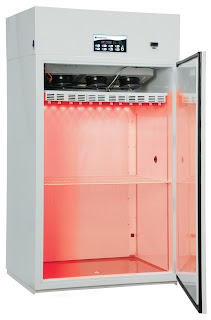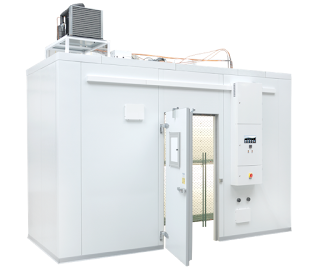
Showing posts with label plant growth chamber. Show all posts

Friday, September 8, 2017

Full Featured Environmental Chamber Control System

environmental chamber control panel plant growth chamber control panel
The IntellusUltraConnect C9 adds a range of remote
connectivity functions to the operational functions of the
IntellusUltra C8.
Image courtesy Percival Scientific
Percival Scientific has a long history of designing and manufacturing environmental chambers and plant growth chambers for life science industries and institutions. Those years of experience are part of the IntellusUltra series of control units that serve as the user interface and operating unit of the company's line of environmental rooms and chambers.

Ease of use is the hallmark of the controllers. Some applications, especially those for plant studies, can require multi-step profiles that change temperature, humidity, lighting, and other functions. Entering or editing a profile with IntellusUltra is intuitive and simple.

In addition to a plethora of operational features, the "Connect C9" version offers a range of remote connectivity functions that can keep users in touch with their equipment and research anytime and anywhere. From the Percival Scientific website...
  • Remote connectivity and monitoring with e-mail notifications.
  • On-board USB connection allowing for real time data logging with up to four gigabytes of data storage. Simply use a portable USB stick to download your data to analyze on any other capable device.
  • An on-board Ethernet connection allows direct monitoring and analysis of chamber conditions.
  • Available remote monitoring software has been optimized to interface with the major web browsers.
  • Ability to upgrade to our cloud-based service securely and confidently monitor and backup your research data
Solid control of environmental parameters, plus connectivity that enables access to the system from anywhere. More detail is provided in the document included below. Share your environmental room and chamber plans and challenges with experienced lab equipment professionals, leveraging your own knowledge and experience with their product application expertise to develop effective solutions.


Sunday, June 4, 2017

Controlled Environment Room Air Flow Matters

controlled environment room top mount refrigeration
Matching controlled environment air flow pattern, velocity,
and volume to the application is part of delivering a well
performing system
photo courtesy Percival Scientific
Environmental chambers, whether of the reach-in or walk-in variety, all rely on the movement of air within their controlled space to attain performance specifications. Various manufacturers will employ differing strategies for chamber air movement, and the manner in which their designs disperse air flow throughout a chamber of any size can have an impact on the work or process held within the chamber.
This article is about controlled environment rooms, but much of what is included here is also applicable to smaller sized chambers.
The design of air flow in a controlled environment room can be impacted by a number of factors, some of which may be based on specific application requirements, and others that may be influenced by cost, production simplicity, or other factors unrelated to the performance goal of the equipment.
What aspects of controlled environment room air flow bear on performance?
  • Velocity - In the common usage of the term when referring to air flow, the speed of the moving air. Depending upon the air moving equipment arrangement and any dispersion devices, such as perforated suspended ceilings or wall plenums, air velocity can vary throughout a chamber. Users should consider how their work may be impacted by air flow velocity. The storage of material in closed and sealed containers may be impervious to air velocity effects because the "product" within the container is not in contact with the moving air. Plants and insects, on the other hand, are an example of items that may be significantly or severely impacted by air velocity. Higher air velocity at a chamber location exposes that location to more air per unit of time. Desiccation is one possible concern that is exacerbated by increased air velocity. Higher velocity can also be beneficial, even necessary, for some applications. Rapid cooling or heating of materials placed within a chamber is enhanced by increased air movement across the material surface.
  • Volume - The volumetric flow of air through a controlled space or chamber is needed to transfer heat to or from the space in order to maintain temperature control. Much of the air in a controlled environment room is recirculated, with cooling, heating, and in some cases moisture applied to condition the air in the room to the setpoint. The volume of air movement is loosely related to velocity, so increasing volume will result in an increase in velocity unless other design changes are made with respect to how the air is dispersed throughout the room. Higher volume, or turnover rate, contributes to better temperature uniformity in the room. As with velocity, there may be application specific requirements for low air movement. Keep in mind that low air movement creates challenges to the attainment of close temperature control and uniformity. 
  • Pattern - The way in which air is distributed throughout the controlled environment room can impact system performance once materials are placed in the room or process work is commenced. Empty chambers generally perform well, regardless of the air flow pattern, because there is little in the way of a load on the system and no solid materials in place to block or redirect air flow. Consideration should be given to the way in which air is dispersed throughout the work area. Loading patterns for stored product or the placement of work in process should be accommodated by the air flow pattern.
Matching the right air flow characteristics to the work to be achieved in a controlled environment room will result in better overall performance, not just when empty chamber tests are conducted, but when real work is being accomplished. 

Share your environmental chamber and controlled environment room requirements and challenges with application experts. The combination of your own experience and knowledge with their specialized technical expertise will yield an effective solution.

Thursday, February 16, 2017

LED Equipped Plant Growth Chambers

plant growth chamber with LED lighting
Plant growth chamber with
overhead LED lighting
Percival Scientific
One of many facets of horticultural study focuses on the impact of light upon plant growth. With the commercial progress made over the recent several years in higher output LED lighting devices, it is now possible to control illumination levels and spectra in a manner not previously available on a practical level.

What is a light emitting diode, or LED? It is a semiconductor device that exhibits electroluminescence, the phenonmenon of light emitting from a material when a voltage is applied. The LED has been around for decades, but was restricted by the state of the art to very low power levels and limited spectral output. As with many solid state devices, innovation and research extended the performance envelope and reduced the cost of the devices to a point where LEDs are currently enjoying a surge of adoption as the light source of choice for many applications.

As far as plant growth research and commercial grow operations are concerned, the advent of high output LED lighting technology provides some notable benefits.

  • For commercial operations, there are cases where light alone has been responsible for delivering higher yields per plant and producing more marketable crops. 
  • LED light sources can be substantially more efficient than other light sources employed for plant growth. This reduction in energy use translates, of course, into a continuing stream of savings, but also reduces the first cost and size of supporting utility infrastructure. Past requirements for electric power, ventilation, or chilled water supply for plant growth chambers and equipment could be formidable. The reduction in energy usage due to more efficient lighting translates into an all around reduction in supporting utilities. 
  • Lower radiant heat emission from LED lighting means plants can be closer to their light source without incurring heat damage, delivering higher lighting intensity at the leaf surface. The lower radiant heat level from LED lighting assemblies, coupled with their comparatively compact form factor, allows placement of lighting modules or units all throughout the growing zone, an application flexibility not previously practical.
  • Lighting level and spectral control is better with LEDs. The devices can be grouped in many ways and are well suited to dimming control, a very cumbersome and costly option with older lighting packages.
For these and other substantial benefits, LEDs will likely be the lighting source of choice for plant growth studies and commercial operations for many years to come. There is more to learn. Share your plant growth chamber requirements and challenges with product application experts, combining your practical experience with their product application expertise to develop an effective solution.