Showing posts with label ultrapure water. Show all posts

Friday, March 16, 2018

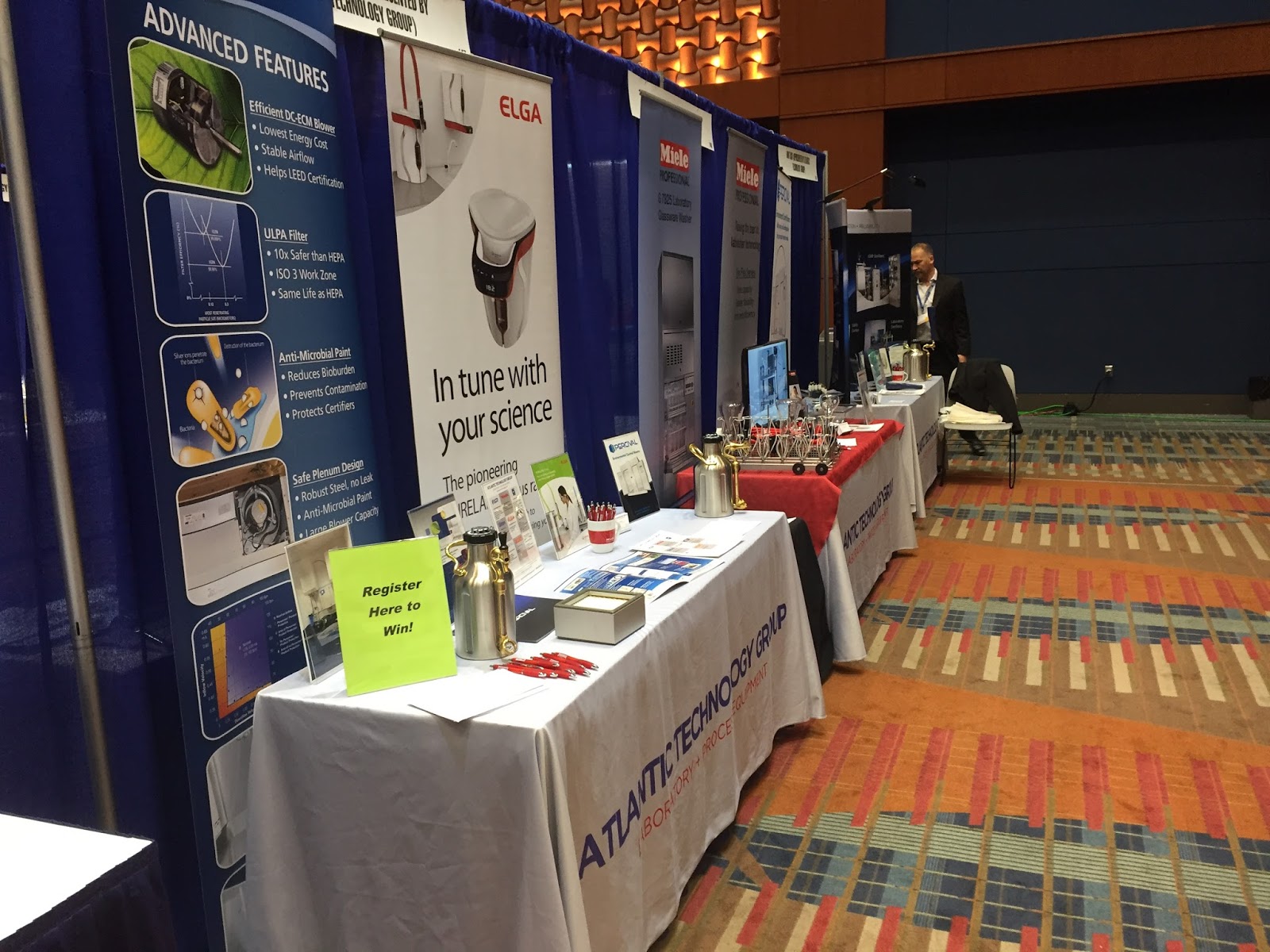
Atlantic Technology Group at ISPE-CaSA 2018

Atlantic Technology Group exhibit display at ISPE CASA 2018
Atlantic Technology Group exhibiting at ISPE CaSA 2018
Atlantic Technology Group attended, supported and exhibited at the 25th Annual ISPE-CaSA Life Sciences and Technology Conference at the Raleigh Convention Center on March 13, 2018. The conference provided everyone with great opportunities to network, socialize, learn, and discuss application and processing challenges with the life science industry. Many stopped by ATG's multi-space display to inquire about products and look for solutions. On display were products from several manufacturers represented by ATG in the mid-Atlantic area.

  • Miele - Large Chamber and Undercounter Laboratory Glassware Washers, Parts Washers, Critical Laundry Washers and Dryers, Specialty Cleaning and Neutralization Agents
  • BMT USA - Laboratory Sterilizers, Bulk Sterilizers, Custom Sterilizers, cGMP Terminal Sterilizers including Vacuum, Steam-Air Mixture, and Water Spray; Clean Steam Generators, Pure Steam Generators
  • Elga - Type 1, Type 2, Type 3 Water Systems; RO, DI, EDI, UV, and Ultrafiltration technologies in compact lab systems to large high-flow whole building loop systems.
  • Esco - Biological Safety Cabinets, Horizontal Laminar Flow Clean Benches, Vertical Laminar Flow Clean Benches, Animal Containment Work Stations, PCR Cabinets, Powder Weighing Balance Enclosures, Compounding Pharmacy Isolators, Ductless Fume Hoods, Ducted Fume Hoods, CO2 Incubators
  • Percival Scientific - Plant Growth and Stability Chambers, Walk-in Controlled Environment Rooms
Thanks go out to all attendees and other participants for a successful conference from the solution providers at Atlantic Technology Group. We look forward to next year's conference and any opportunity to assist a customer in solving a problem, meeting a challenge.

Wednesday, November 15, 2017

Water Purification Knowledge for Laboratory Applications

laboratory water purification unit with dispensing user
Specifying lab water purity requirements based on
application and matching water purification equipment
to the requirements delivers a cost effective solution.
Image courtesy ELGA
Purified water is essential to a broad range of laboratory operations. Creating a match between the lab process requirements for purity and quantity with the performance ratings of water purification equipment can be challenging. The time spent creating a solid plan will pay dividends for the life of the equipment selected.

ELGA, a member of Veolia Water Technologies, focuses on the treatment of water for laboratory use. They have condensed the subject of laboratory water purification into a modest sized document that covers several facets to be considered when planning a lab water system.

  • Why water purity is important for every lab application
  • The things you need to know about water impurities
  • Water purification technologies available
  • Matching the water purity standard or specification for your application
  • Practical considerations for installing a water purification system
  • The future of water purification in the lab
The full document is available upon request. Share your water purification requirements and challenges with application experts. Leverage your own knowledge and experience with their product application expertise and develop an effective solution.

Thursday, November 9, 2017

Two Key Recommendations for Purifying Your Laboratory Water

laboratory water purification equipment point of use station with technician drawing sample
Assessing the demand for various grades of purified
water in the laboratory can lead to a cost effective approach
to equipment specification and purchase.
Image courtesy Elga
In this post we share the expertise and knowledge of a globally recognized leader in water purification for laboratory and process applications. Elga Lab Water has been delivering cost effective solutions for converting all types of source water into various purified grades for research and industrial use. Below, with only minor editing to accommodate this publishing format, is a short article published by the editorial staff at Elga. It provides the two most basic, and most important, recommendations for consideration in selecting a water purification system for your lab.

From the Elga staff....
The water in your tap has already gone through several purification steps to keep you safe and yet it still contains all sorts of impurities like microorganisms, salts (the reason why you would get electrocuted if you dropped a hair drier in the bathtub) and organic compounds. Suddenly, water that’s pure enough to drink might not be quite as pure as you thought.

In the lab, water is perhaps your most important reagent (and its position as the universal solvent means that it is probably also a component of many other reagents you use). Impurities, on the other hand, are usually your enemy. You should be using different levels of purity for different applications, to avoid problems caused by contaminants (all while minimizing financial cost). Pre-treating water is a great way to obtain a lot of water sufficient for a wide range of low-purity applications, and you can use this water in further steps of purification for those applications that are more demanding. The type of purity required depends on the application the water is for, and you can save money by making sure you chose the right type. Read on to find out more about these two cost-saving tactics.

Recommendation 1: Pretreat your water to cut down costs

Let’s assume your water has made it to the tap. It’s come out of the ocean or Earth’s deep underground storage, through modern water treatment works and into the pipes. You could take small amounts of this and purify it to high levels, but a more economical and efficient option is to start with pretreatment, which takes large quantities of water to a level of purity that is already appropriate for some uses, like preparing cleaning reagents. This allows you to take advantage of economies of scale and prevents you from using more expensive water for rudimentary applications such as cleaning. You can then use this water as a precursor for higher levels of purification. To pretreat water, you pass large volumes through compressed fibers that filter out particles of a nominal size. Activated carbon (AC) is relatively cheap (you’ll see it in many hikers’ backpacks these days for emergencies) and you can use this to remove chlorine, chloramine and organics.

Recommendation 2: Choose a water treatment option based on your needs

After pretreating your water, you have several options for removing different impurities. Which one you choose should depend on the type of experiment you plan to carry out:
  • Reverse osmosis (RO) – uses semi-permeable membranes to typically remove over 95% of ionic and organic contaminants. Dissolved gases are not removed. 
  • Ion exchange (IX) – cartridges or cylinders containing resin with small porous beads. They need regular replacement but are relatively cheap. Other contaminants such as bacteria remain. 
  • Electrodeionization – combines features of RO and IX. 
  • Filtration – finer filters than those used for pretreatment. Removes colloids, bacteria and particulates and with the finest filters can remove nucleases, endotoxins and organics. 
  • Ultraviolet (UV) 
  • Distillation – removes contaminants that don’t evaporate with water. 
  • Degassing – uses a hydrophobic membrane and a vacuum or flush gas to remove gases such as CO2 and O2. 
  • Vent filters – can be fitted to reservoir to prevent contaminants entering stored water. 
Designing a cost effective water purification equipment system can be challenging. Share your requirements with a water purification specialist, leveraging your own knowledge and experience with their product application expertise to develop the best solution.

Monday, January 23, 2017

Conference and Trade Show Schedule for 2017

Atlantic Technology Group will be an active participant in a number of conferences and exhibitions in the life science industries throughout 2017. Their participation is part of a continuing effort to support the academic and trade organizations in the industries ATG serves. New product and application information, as well as the face to face exchange of viewpoints and ideas are a hallmark of these conferences. Review the schedule and make arrangements to attend one this year.

Reach out to Atlantic Technology Group for more information about registration or attendance at any of these events.
Pittcon Conference & Expo
March 5-9
Chicago, IL
Interphex
March 21-23
Javits Center, NYC
Mid-Atlantic Life Sciences Showcase
April 6

Life Sciences Technology Conference
March 14
Raleigh, NC


Laboratory Design Conference
April 24-26
Raleigh, NC

2017 Biomedical Research Equipment
and Supplies Exhibit

May 2
Ft. Detrick
Frederick, MD

In Vitro Biology Meeting
June 10-14
Raleigh, NC